
The most frequent cause of infections in chronic wounds involves antibiotic-resistant bacteria, including Staphylococcus aureus and Pseudomonas aeruginosa. The pathogens that dominate non-healing wounds show resistance to standard antibiotics, thus causing prolonged wound healing and higher infection risks. The rising antibiotic resistance worldwide requires new non-invasive solutions to control infections that avoid creating further resistance problems.
Femtosecond laser-based therapy provides a solution to kill bacteria through its application of ultrashort laser pulses. The Inspire OPO from Radiantis with Mai Tai Ti:sapphire oscillator pumping delivers precise control and stability needed to remove specific bacterial pathogens while protecting nearby healthy tissue.
Prof. Dr. Tarek Mohamed with his research team at the Laser Institute for Research and Applications (LIRA), Beni-Suef University, Egypt demonstrated the Inspire OPO’s ability to kill Staphylococcus aureus and Pseudomonas aeruginosa in a laboratory setting. The research results demonstrate femtosecond laser-based therapy’s potential as a non-invasive chronic wound infection treatment and open opportunities for clinical use.
The objective of the study was to find the best laser settings, specifically the wavelength, together with exposure duration and power density, to stop bacterial development. The scientists worked to develop a setup that would deliver maximum bacterial elimination while being suitable for clinical application.
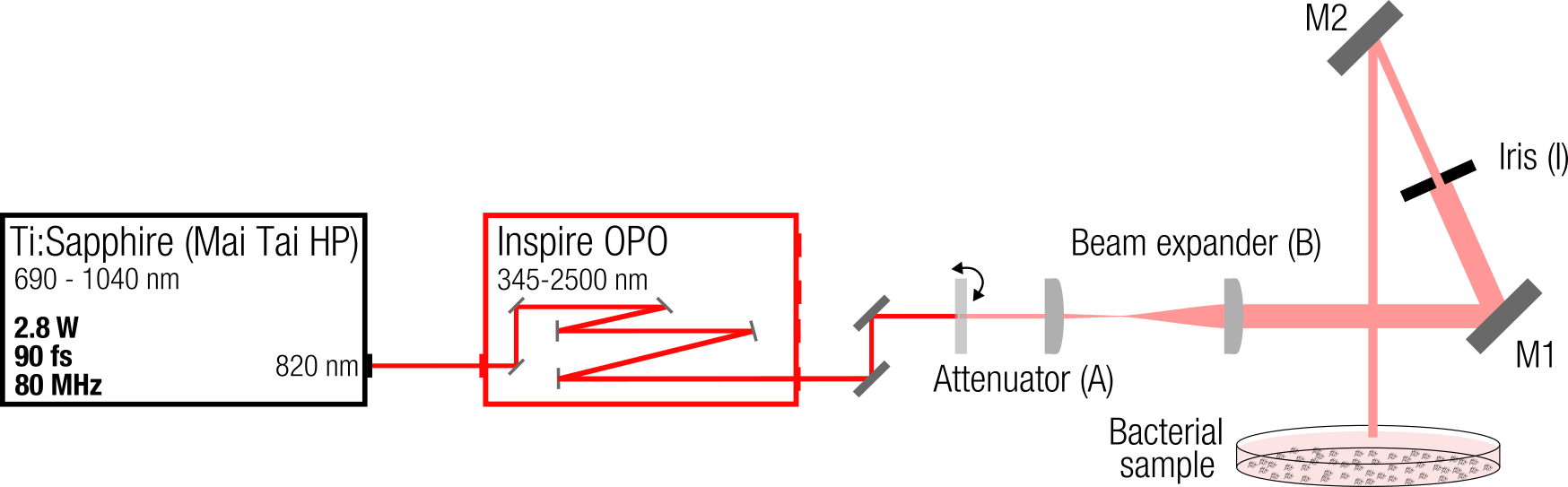
Figure 1 displays the experimental arrangement that was used in this research. The Inspire OPO operated by the Mai Tai Ti:Sapphire oscillator produced 100 fs pulses, which passed through multiple mirrors and lenses to achieve accurate focusing and alignment. The laser intensity for S. aureus and P. aeruginosa cultures was managed through an attenuator, and the laser beam size could be adjusted using an iris. The samples were placed inside agar plates, which were maintained under sterile conditions at controlled temperatures. The laser irradiation was performed under carefully monitored conditions, and the bacterial cultures were subsequently observed over a period of seven days to assess the persistence of the bactericidal effect.
In the first part of the experiments, the effect of different power densities ranging from 0.0348 to 0.047 W/cm² was examined at a fixed wavelength of 370 nm. Exposure times varied from 1 to 9 minutes. In the second part, the response to a wide range of wavelengths from 380 nm to 800 nm was tested at a fixed power density of 0.047 W/cm². For the second part, each agar plate was divided into three sections, with each section exposed for 5.5, 7, or 10.5 minutes. Finally, to optimize the bactericidal effect, a narrower wavelength range of 370–420 nm was tested at a slightly higher power density of 0.063 W/cm². Exposure times were extended to 5, 10, 15, and 20 minutes. These parameters were chosen to induce meaningful bacterial inhibition without causing thermal damage to the substrate or surrounding environment. Following each treatment, the plates were incubated at 37 °C for 48 hours, and bacterial growth inhibition was assessed by observing clear zones on the agar. The experimental results demonstrated that both S. aureus and P. aeruginosa responded similarly under optimal femtosecond laser conditions. At shorter exposure times (1–3 minutes), no bactericidal effect was observed. However, a significant inhibition zone appeared at an exposure time of 9 minutes and a power density of 0.047 W/cm². In the second phase of the experiment, only wavelengths within the ultraviolet to blue light range (370–420 nm) produced bactericidal effects, highlighting the strong wavelength dependence of the laser’s antimicrobial action, as illustrated in Figure 2.
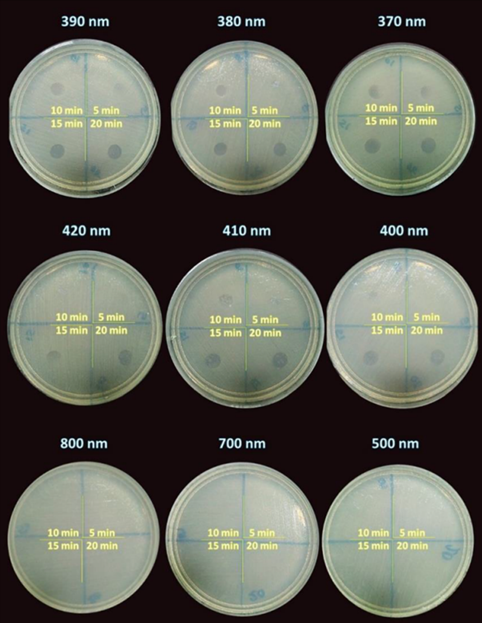
The research showed that the bactericidal response depends on wavelength, but longer wavelengths in the near-infrared spectrum do not produce any inhibitory effects. The treatment produced enduring effects because no bacterial regeneration or resistant mutants appeared after seven days of observation. Femtosecond laser therapy appears to be an effective antibiotic-free solution for treating chronic wound infections.
The Inspire OPO system provides non-contact wound surface disinfection while enabling precise pathogen elimination that protects the host tissue. The clinical integration of this system would improve chronic wound management for cases involving antibiotic-resistant bacteria. Research efforts should focus on applying these laboratory outcomes to live models as well as developing deeper tissue penetration capabilities and integrating imaging technology to provide real-time feedback and treatment monitoring.
For further details regarding femtosecond OPO systems in research and development, contact us through sales@radiantis.com.
References
Ahmed, E., El‑Gendy, A. O., Moniem Radi, N. A., & Mohamed, T. (2021). The bactericidal efficacy of femtosecond laser‑based therapy on the most common infectious bacterial pathogens in chronic wounds: An in vitro study. Lasers in Medical Science, 36(3), 641–647.
Share article

